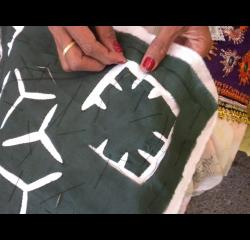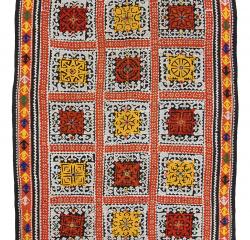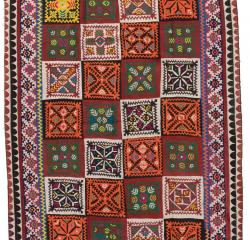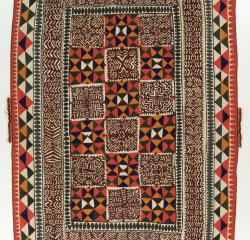
A second common technique used to decorate ralli quilts is appliqué. In appliqué, a piece of fabric cut into a design is sewn onto a base fabric. A natural plant paste is sometimes applied to help keep the motif in place during sewing. Appliqué designs range from simple circles, flowers, vines, peacocks, and elephants to highly complex patterns with lines as narrow as ¼ inch. Many patterns are called "flowers," but the specific type is usually unnamed, with the eight-petal lotus being a notable exception. Appliqué mandherro crosses—a motif based on the head of a milk churn—are also commonly found in quilt borders.
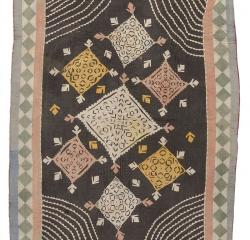
Some of the simplest appliqué quilts are called “new design.” These begin with a solid piece of black, blue, red, or other color fabric large enough to form the center field, which is then decorated with appliquéd designs in contrasting colors and shapes. The elements are often arranged in a loose symmetry around the center. Women like this design because it is quicker to make than block-based designs, which require piecing many separate blocks.
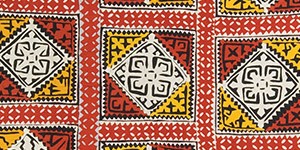
The quilts most renowned for their appliqué work come from Upper Sindh and the area of Rahim Yar Khan in Punjab Province. Makers there construct appliqué blocks much like someone would make a paper snowflake: they fold a square of fabric into quarters, eighths, or more and cut designs through all the layers. The fabric is unfolded, set in place with basting stitches or plant glue, and sewn to the background fabric by turning under the raw edges and using a fine hem stitch. The results are intricate, delicate designs that seem almost unbelievable in their precision. These blocks are often paired with alternating blocks of patchwork or embroidery. In Upper Sindh, this appliqué is frequently combined with borders of equal complexity.