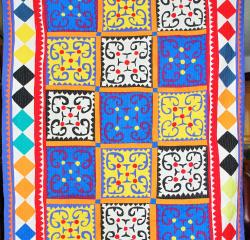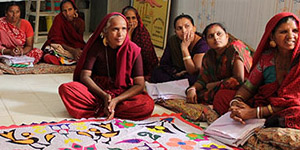
Historically, rallis were made at home by women for use within their families or as gifts. Over the past several decades, however, women’s cooperatives have formed throughout the ralli region, enabling women to use their sewing skills to earn extra income by making and selling rallis. Some quilts are sold in local craft markets to buyers who appreciate traditional quilts or seek them as wedding gifts.
For some families, making and selling rallis is a means of survival. In the temporary camps established after the 2010-11 floods, women used donated clothing to piece quilt tops, which they sold to neighboring communities. While living in the camps, quilting was the only skill they could rely on to earn money while still caring for their children.
One example of a cooperative in the Thar Desert region of Lower Sindh, Pakistan, is Lila Handicrafts. Founded in 2004 by Mr. Surendar Valasai, it gave women in his family and village—primarily Hindu Dalits, a historically marginalized community—with an opportunity to use their textile skills to generate income. The cooperative grew to more than 200 quilters by 2016. Much of the income has been used to hire teachers, support the local elementary school, and develop a secondary school. One of the graduates is now working on his Ph.D.
In India, Rajasthan and Gujarat both have thriving quilting industries. Jaipur, in Rajasthan, has a dynamic industry producing fluffy quilts printed with Mughal-inspired designs. In the Barmer region, companies specialize in appliqué quilts sourced from home-based industries. Gujarat is home to numerous cooperatives, craft schools, and businesses that make quilts based on traditional designs and block-printed fabrics. These groups play an important role in sustaining the region's intricate embroidery and quilting traditions.