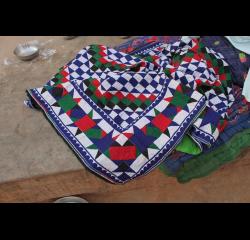
For countless centuries, rallis were valued for their utility and beauty, for preserving traditional colors and symbols, for offering women a means of personal expression, and for signaling family wealth. As with many cultural traditions that require years of training and significant labor, ralli quilts have now reached a point—perhaps for the first time in thousands of years—where they are no longer produced or valued as they once were. Sadly, this mirrors the fate of many crafts and folk arts around the world.
Given that millions of people once slept under rallis every day, the decline of this tradition may seem almost unimaginable. Yet several factors have likely sped up the change. One is the shift from cotton to synthetic fabrics. Another is the loss of countless family quilts to flooding and other disasters. A further influence may be the proliferation of cell phones. Researchers observed in rural India that teenage girls who once spent their leisure hours beside their mothers learning to sew and make rallis now spend that time on their phones or watching television. As a result, far fewer young women acquire the skills needed to continue the tradition. Some estimates suggest that ralli production today is only a quarter of what it was in 2000.
A more recent development is the sale of synthetic cloth printed with ralli-like designs, complete with printed borders. These wide, pre-printed fabrics are long enough for quilt tops, allowing a woman to sew them to a backing with filling and achieve a ralli-like result with only a fraction of the cost and labor. The printed motifs often combine elements from multiple regions and use a variety of color schemes. In this commercial adaptation, the integrity of the original designs becomes confused or lost.