

The mighty Indus River flows through much of the ralli region. It brings water and life from the mountains of the Himalayas, crossing a vast arid landscape before emptying into the Indian Ocean. For millennia, it has made agriculture possible across a broad expanse of the Indian subcontinent. In ancient times, the river was revered almost as a deity. The Vedas—ancient hymns first recorded around 1000 BCE—contain verses praising the river: “From the mountainside the Sindhu (Indus) comes rolling like a bull, as from the clouds the waters rush amid the roll of thunder. The other rivers run to pour their waters into thee.” Because of the Indus, the region of Sindh was described as “rich in horses, rich in chariots, rich in cloths, rich in gold ornaments well made, rich in wood forever fresh…”
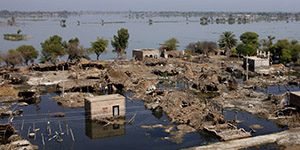
Yet the same rivers that sustain life and agriculture can also bring destruction. In 2010, excessive monsoon rains caused the Indus to flood catastrophically. By late July and throughout August, the river swelled to more than 20 miles wide in places—visible even from space. The flooding affected 20 million people and caused an estimated $43 billion in damage to property, infrastructure, and livelihoods. More than 2,000 people died, and 11 million remained homeless a year later when renewed rains flooded parts of Lower Sindh that had escaped the previous year's devastation. Severe flooding struck the area again in 2022, causing further widespread destruction.
During these crises, the significance of rallis was evident in countless photographs of families fleeing their homes carrying their most prized possessions—including rallis—often carried overhead to keep them dry. For many, these quilts were not only useful items to sleep with but tangible reminders of home, community, and the women who made them. Despite valiant attempts to save them, many rallis were lost to the floods, taking with them visual memories of patterns and designs central to the region’s heritage. The 2001 earthquake in Gujarat, India, likewise caused great destruction, loss of life, and loss of material culture. With the deaths of older women in some communities, shared knowledge of quilt patterns also disappeared.


