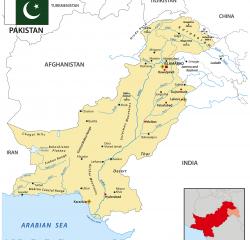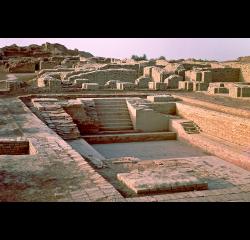
The Indus Valley region has long been recognized as the home of ancient civilizations spread across a vast geographic area. Archaeological expeditions in the twentieth century uncovered settlements dating as far back as 8000 BCE. The long-lived settlement at Mehrgarh in Pakistan flourished from around 7000 to 2600 BCE, followed by the Indus Valley Civilization, which spanned from roughly 2500 to 1500 BCE. Ruins such as the city of Mohenjo-daro, located on the west bank of the Indus River, reveal a flourishing urban community with monumental architecture, plumbing, city services, thriving trade, and little evidence of war. Unfortunately, no written texts have yet been deciphered to provide further insight into these early peoples.
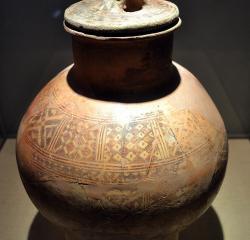
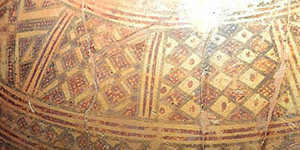
Symbols and designs that appear on ancient pottery are especially important to the story of ralli. Excavations at the city of Pirak (1800-800 BCE) in today's Baluchistan, Pakistan, uncovered a wealth of highly decorated pottery with intricate geometric designs. These motifs appear to have been in use for nearly a thousand years before giving way to simpler styles. Small fingerprints found on some pots have led some experts to believe that women may have been the painters.
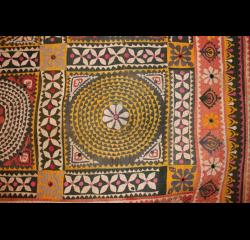
Dozens of patterns on the Pirak pots correspond to designs found on rallis today. These include thick zigzag lines, bold patchwork-like squares, squares set on point, strong triangular borders, and intersecting lines that form blocks. Border designs on pots closely resemble those on ralli quilts. One example has a row of triangles, each with a small circle at its tip, a traditional border design still used in rallis in Lower Sindh.
Some may argue that geometric designs are universal and that similarities arise by chance. Yet the specific correspondences between ancient pottery and modern rallis suggest that these designs may have been passed down through generations. It is intriguing to imagine that such designs could have been transmitted from mother to daughter for thousands of years: the enduring power of tradition.