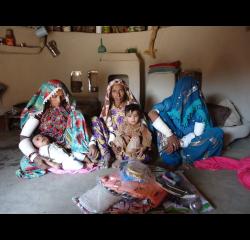
The women who make rallis are closely connected to the villages where they live. Most have limited formal education and may only speak the village language, which can differ from the district or regional language. Their world centers on family, children, community, and religion. They work long hours caring for relatives, preparing food, getting water and fuel, and contributing to agricultural labor or tending animals. Traditionally, women rarely leave their villages.
A visitor walking down a village street in southeastern Pakistan or western India might immediately notice the vivid colors of the women’s clothing. Bright tunics and flowing pants (shalwar kameez) paired with a long, printed headscarf may indicate that a woman is from a Muslim village or comes from a farming family. In Hindu villages, she might wear a full-length skirt with an embroidered blouse and scarf. Across villages, men’s clothing is typically the only attire in subdued colors. Ralli quilts share the same vibrancy. In small, simple homes, they are often stacked neatly against a wall, sometimes covered with a special ralli (daraniyo) as a protective layer. The pile of quilts in the corner of a home stands as a testament to women’s creativity, skill, and industriousness. In this part of the world, owning many quilts signals a family’s wealth, and women contribute significantly to household prestige through their handiwork.